How to Calculate Your Retirement Income Needs (Step by Step)
 Posted in Uncategorized last updated on August 8, 2026
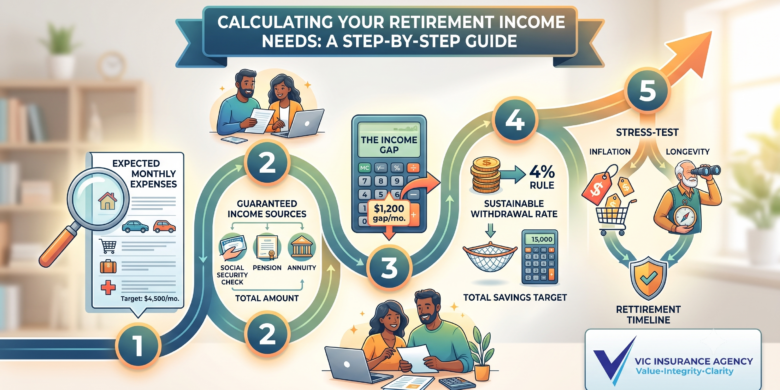
“How much do I need to retire” is the wrong first question. The right one is “how much income do I need per month once I stop working, and where is it coming from.” One is a guess. The other is math you can actually check your progress against. Here’s how to do that calculation the right way.
Step 1: Start With Your Expected Monthly Expenses, Not a Lump-Sum Number
Retirement planning often gets reduced to a single scary number, like “you need $2 million.” That figure means nothing without context. What matters is your monthly income need: housing, healthcare, food, travel, and discretionary spending, adjusted for what actually changes in retirement (no more commuting costs or retirement account contributions, but likely higher healthcare spending).
A common starting estimate is 70 to 80 percent of your pre-retirement income, but that’s a rough baseline, not a rule. Someone planning extensive travel or expecting higher medical costs may need closer to 100 percent or more.
Step 2: Inventory Your Guaranteed Income Sources
List what you’ll receive regardless of market performance:
- Social Security (your estimated benefit, adjusted for the age you claim)
- Pension income, if applicable
- Annuity income, if you hold or plan to purchase one
This is your income floor, the amount that arrives no matter what markets do.
Step 3: Calculate the Gap Between Guaranteed Income and Your Needs
Subtract your guaranteed income from your monthly expense target. The difference is what your investment and savings accounts need to produce. This gap is the actual number your retirement plan needs to solve for, not your total net worth.
Step 4: Apply a Sustainable Withdrawal Rate to Your Savings
Once you know the income gap, you can work backward to figure out how much saved capital is needed to cover it. A commonly used starting point is a 4 percent annual withdrawal rate, though the right rate for you depends on your time horizon, other income sources, and risk tolerance. This step is where a lot of DIY retirement math goes wrong, because it’s easy to either underestimate how long retirement savings need to last or overestimate what a portfolio can sustainably produce without running dry.
Step 5: Stress-Test Against Inflation and Longevity
A monthly income need that works in year one of retirement doesn’t stay fixed. Inflation erodes purchasing power over a 20-to-30-year retirement, and living longer than expected (which, statistically, is the more likely outcome to plan for) means the math needs to hold up over a longer runway than most people initially assume.
Where This Math Gets Complicated
The steps above are straightforward individually. Where it gets harder is coordinating them: figuring out optimal Social Security claiming age, deciding how much guaranteed income to layer in through an annuity versus keeping assets liquid and market-exposed, and stress-testing the whole plan against inflation, longevity, and long-term care costs at the same time. Running this by hand or with a generic online calculator usually misses at least one of those variables.
How VIC Insurance Agency Can Help
This is exactly the kind of calculation VIC Insurance Agency’s retirement income tools are built for. Rather than a generic “how much do I need to retire” estimate, our retirement calculators walk through your specific guaranteed income sources, expense targets, and time horizon to show you where your income gap actually sits, and what options (including annuity income, IUL, and other tools) could close it. If you want an actual number instead of a rule of thumb, that’s the starting point.
The Bottom Line
Calculating retirement income isn’t about hitting one giant savings target. It’s about knowing your monthly income need, what’s guaranteed, what the gap is, and whether your plan can sustain that gap for as long as you might need it to. Once you have those numbers, “how much do I need to retire” stops being a guess.
About the Author Victor Rodriguez, LUTCF, is the owner of VIC Insurance Agency LLC, an independent life and retirement solutions agency licensed in AZ, CA, CO, ID, MT, NC, NJ, NV, OR, TX, UT, and WA. Based in the Boise/Meridian, Idaho area, Victor uses VIC Insurance Agency’s retirement income calculators to help clients turn retirement savings into a clear, sustainable income plan.
📞 208-617-5829 | 📧 Victor.Rodriguez@vicagencyllc.com | 🌐 www.vicagencyllc.com